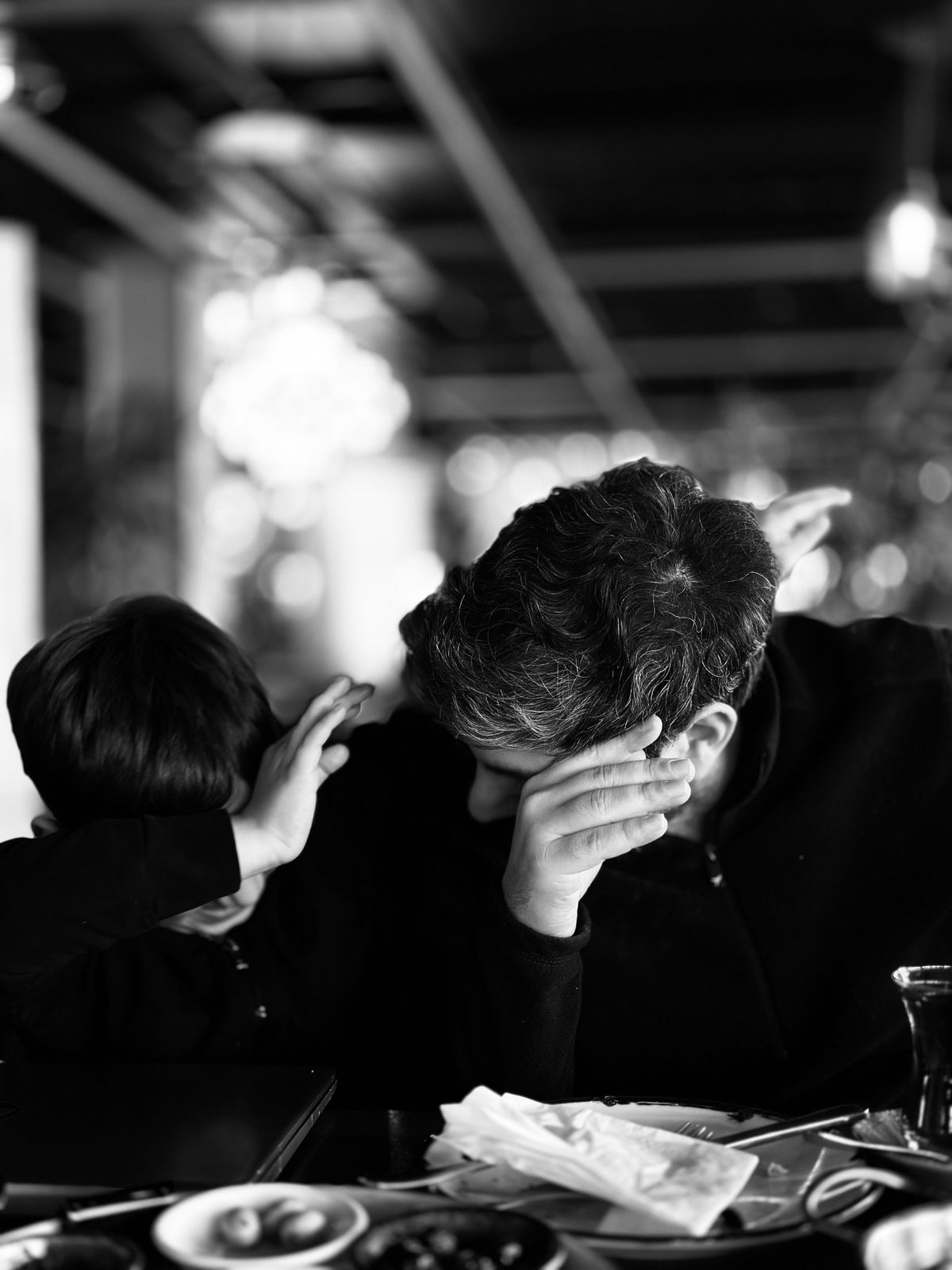
Last week, a custody fight between two Hollywood actors spilled into the headlines. One parent accuses the other of attacking their 12-year-old son. The other calls the accusation meritless. What happened that night is for a court to decide, not me. But one detail stuck with me. In a text reported by TMZ, the boy's mother asked his father whether their son wanted to fight his own mother, and told him that shouldn't be okay with him as a father.
Set the gossip aside and look at what's left. A preteen boy accused of wanting to fight his mother. Two parents fighting it out in court instead of standing together. Millions of people watching. This isn't one family's problem. It's a symptom of something much bigger, and it raises a question every man should be asking: what are we teaching our sons?
I started Aeilus because so many men, young and old, are struggling to find their way. They're struggling to connect, and struggling with their mental and physical health. Loneliness among young people is at historic highs, and the deficiencies show up in nearly every area of our lives. So how do we begin to fix what's plaguing our society? More importantly, where do we start?
I don't believe there's a single fix. Our biggest problems need a multifaceted approach. But where we start is a much clearer answer: men need to be fathers and role models to their sons. We need to return to standards in how we raise children, and one of those standards should be non-negotiable. Respect.
Respect starts at home
A child who doesn't respect himself won't respect anyone else. Not his parents, not his teachers, not his elders, and not the society he's about to inherit. Self-respect and respect for others aren't two separate lessons. They're the same lesson, and it's learned in the same place: home.
I see parents posting photos of their kids holding up their middle fingers. When did this become okay? It's disrespectful, and frankly gross, for a child or teenager to wave their middle fingers at a camera, and worse that a parent thought it was worth sharing. Recently I saw another video of a kid telling their mother to "stfu" on camera, as if it were content.
It doesn't stay online. Teachers see it every day. In 2022, the National Center for Education Statistics reported that about half of public schools saw an increase in student disrespect toward teachers and staff since the pandemic began.
Kids behave this way because it's been allowed. If you don't expect respect from your children, you're not going to get it. Think about classic TV like Leave It to Beaver or The Andy Griffith Show. You couldn't imagine one of those kids talking to their mother that way, and audiences wouldn't have stood for it. Somewhere along the way we lost our sense of decency, and suddenly everything became acceptable.
When a son raises his hand
I'll say what a lot of people are thinking. When a son raises his hand to his mother, his father has to correct him. Not tomorrow. Not after a lawyer weighs in. Right then. A father who stays silent, or worse, takes his son's side, is part of the problem.
Parents won't always agree, and after a divorce they may not agree on much of anything. But disagreements between parents belong in private conversations, away from the kids and away from the public. A boy needs to see his parents stand together on respect, even when they can't stand together on anything else. When parents fight their battles in courtrooms and comment sections, the child learns that if Mom tells him something he doesn't like, Dad will back him up. Or the other way around.
To be clear, none of this gives any parent the right to put hands on a child in anger. Discipline and abuse are not the same thing, and a father's job is to protect his son, too. But protecting your son and correcting him aren't opposites. A father who loves his son does both.
Here's the hard truth: a boy who will raise his hand to his mother will raise it to any woman, and to anyone else he isn't physically afraid of. That lesson gets learned, or unlearned, at twelve. Not at twenty-five.
Correction with love
As men, we're supposed to correct with love, and that correction should come swiftly. When it doesn't, we see the results in our streets: teen "takeovers" where crowds of kids overrun downtowns and malls, and stories like the Chicago mother who was beaten on camera near her son's elementary school last year. She had spent two years telling the school her son was being bullied. Seven children, ages 10 to 13, were charged in the attack, which also put her 9-year-old son in the hospital.
The numbers behind the crisis
None of this is happening in a vacuum. Young people today are lonelier, more anxious, and more hopeless than the generations before them.
A 2025 report from The Cigna Group classified 67% of Gen Z adults as lonely, compared with 44% of baby boomers.
A Pew Research Center survey found nearly a quarter of Americans ages 18 to 29 felt lonely, compared with just 6% of those 65 and older.
In the CDC's 2023 Youth Risk Behavior Survey, nearly 4 in 10 high school students (39.7%) reported persistent feelings of sadness or hopelessness, and 1 in 5 had seriously considered suicide.
The suicide rate for Americans ages 10 to 24 rose 62% from 2007 to 2021. For kids ages 10 to 14, it tripled between 2007 and 2018.
These aren't abstractions. These are our sons and daughters.
Fathers make the difference
The family nucleus, with parents working together, is where the tide starts to turn. And the research backs up what many of us already know from experience: boys need their fathers.
The share of boys growing up without their biological father in the home has nearly doubled since 1960, from 17% to 32%, according to the Institute for Family Studies.
Boys who grew up with their father at home are more than twice as likely to graduate college by their late 20s. Boys with absent fathers are more than twice as likely to end up in jail.
Economists Deborah Cobb-Clark and Erdal Tekin found that adolescent boys engage in more delinquent behavior when there's no father figure in their lives, and that a father figure who isn't the biological dad still makes a real difference.
That last point matters. Not every boy has his father at home. But every boy deserves a man who shows up.
Back to the basics
The answer is to return to the values of simpler times. Respect for your elders was a big one in my house. It wasn't up for debate. It was expected, so it was given. Men took active roles in disciplining their children. Discipline doesn't mean hitting. Discipline means consequences, and that looks different for every family. What mattered was that it was handled within the family.
Fathers need to be active in their sons' lives so they learn which behaviors are acceptable, and they need to draw a hard line at the ones that aren't, like raising a hand to their own mother. Fathers also need to show their daughters what a real man looks like, and then actually model it, so they know how they deserve to be treated in a relationship. All of this comes back to a father being a father.
Meet the moment
Every father will face a moment when his son tests the line. How he responds, whether he steps up or steps aside, will teach that boy more than any lecture ever could. That moment is coming for every one of us. Meet it.
So I'll ask the question again, to every man reading this: what are we teaching our sons?
Because they're learning either way. They learn it from how we speak to their mothers, how we handle conflict, what we let slide and what we refuse to tolerate. A boy who is taught respect learns to respect himself. A boy who respects himself is harder to break, less likely to drift into isolation, and more likely to grow into the kind of man his own son will one day need.
The fix for a lonely, anxious, angry generation won't come from an app or a policy. It starts at home, with a father who shows up, sets the standard, and holds it with love. Our sons don't need us to be perfect. They need us to be present.
Be the father. That's where it starts.
If you or a young man in your life is struggling, call or text 988 to reach the Suicide & Crisis Lifeline.
Sources
CDC, Mental Health and Suicide Risk Among High School Students, YRBS 2023
CDC NCHS, Suicide and Homicide Death Rates Among Youth Aged 10–24, 2001–2021
NCES school data on student disrespect, via The Washington Post
Institute for Family Studies report on boys and fathers, via The Federalist
Cobb-Clark & Tekin on father figures and delinquency, via Freakonomics
TMZ, Halle Berry ex Olivier Martinez restraining order filing
ABC7 Chicago, 7 kids charged after woman, children beaten near South Side CPS school